
Curing Diaper Rash
As an Amazon Associate I earn from qualifying purchases. For more details, please see our disclosure policy.
The following is written by LifeasMOM contributor, Lauren:
Want to save this post?
Enter your email below and get it sent straight to your inbox. Plus, I’ll send you time- and money-saving tips every week!
If you have a little one, it is almost inevitable that he will battle diaper rash at some point. Whether it is diaper rash as a side effect from medicine or from a reaction to certain diapers, it can be a tough problem to cure.
While there are many good diaper creams on the market, there are also some simple things you can do to make diaper rash less painful for your little one.
Ways to Combat Simple Diaper Rash
Skip the Disposable Wipes
While diaper wipes are ultra convenient, they are filled with chemicals. When using them on broken skin, the wipes can irritate the skin further and cause a reaction that looks like a burn – and feels like one too! Disposable Wipes seem to only make diaper rash worse because they don’t give the skin a chance to heal.
Use Warm Water and Gentle Soap
Instead of using disposable wipes on bums with diaper rash, simply use plain warm water on a clean washcloth. If you need to use soap, only use a small amount of gentle “baby” soap. The fewer soaps, detergents and chemicals on your baby’s skin during this time, the better.
Use a Barrier Cream
Choose a good barrier cream that has an ample amount of zinc oxide. Be faithful in using it every time a diaper is changed.
Change Your Baby Often
Babies should have their diapers changed often – every couple of hours at least. Even though most modern disposable diapers are made to hold 6-8 hours of urine doesn’t mean that they should. The more frequently a baby is changed, the quicker simple diaper rash will heal.
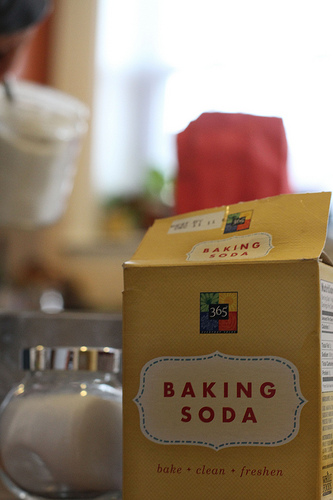
photo source
But what about the kind of diaper rash that doesn’t respond to diaper creams? Or using plain warm water at changing time?
Here are two great tricks we use to treat the more difficult type of diaper rash when it shows up at our house. You know the kind: the rash that comes when a baby is taking antibiotics or has loose stools during a stomach bug. It can be heartbreaking to change diapers when it hurts your little one so terribly!
Use Baking Soda
Baking soda is my go-to resource when battling a really bad case of diaper rash. Its healing properties haven’t failed me yet! Here’s my method:
Each time I change a diaper, I wash the baby’s bottom with a mixture of warm water and baking soda. I dissolve 2-3 heaping tablespoons of baking soda in about 3-4 cups of water and then dip my washcloth in the solution prior to washing the baby’s skin. Then I use another dry washcloth and lightly pat the skin dry before fastening the diaper. Don’t rub the skin dry, as you want the baking soda solution to stay on the skin to decrease acidity.
If I know that I’m going to need the baking soda solution all day, I make a batch in the morning and place it in an old wipes container and out of reach of my other littles. If you choose to make one
container for the day, make sure you use a clean, dry washcloth each time you use your solution to avoid contaminating it.
Also, at bath time I bathe the baby in a baking soda bath. I use about 1 full cup of baking soda in a bath tub of water. Pour the baking soda into the tub and dissolve while filling the tub with warm water. Again, make sure to pat the skin dry as to not rub off the baking soda.

photo source
Liberally use Lanolin
Mothers tend to think of lanolin in relation to the early days of breastfeeding. But it has so many other healing and soothing properties! It is an excellent skin barrier and can safely be used on broken skin where other creams cannot.
To use lanolin, squirt a small dime-size amount on the ends of your fingers and “work it” between your fingers a few moments. The heat of your skin will make it more pliable and easy to work with. After it becomes more elastic, simply dab it onto your baby’s skin. Put it on anywhere the baby’s skin needs protection. This is an especially good product to use at night time when your baby won’t be changed as
often.
When to See the Doctor
Some cases of diaper rash just can’t be treated at home. Occasionally they can progress into yeast or a secondary infection. If you have concerns about your baby’s diaper rash not healing or not responding to your treatment at home, go ahead and give your pediatrician a call.
What’s YOUR cure?
Do your babies have experience with frequent diaper rash? What have you found to be the best at-home treatment methods?

– Lauren Hill is the ‘Mama’ behind Mama’s Learning Corner, a site that features all kinds of educational ideas and tips as well as free printable worksheets. She is the mom of four young children and loves to learn alongside them.



My go-to cure for diaper rash was to put a cup of epsom salts in the bath. It always worked wonders, and I found that it was comforting to me when I had a yeast infection or postpartum hemorrhoids.
My go to solutions have always been cornstarch (I would imagine its similar to using baking soda), then if it doesnt go away a healthy dose of Aveeno Diaper Cream and Penaten. The cornstarch is known to make yeast-related rashes worse, so if I dont see things clearing up in a day or so, I switch to the Aveeno.
Penaten at every change while the rash is around.
All of my kids and the ones that I keep can’t use the wipes from the store either. We use homemade wipe made with half of a papet towel roll, baby soap and baby oil and water. This keeps them clean, but no irritation!
We had success with Triple Paste for diaper rash and also rashes from bathing suits in the ocean water. It would clear these up overnight it seemed. When my kids were babies, I would also let them “air out” on some thick towels on the floor each day if they seemed rash-y – that always helped.
I found all of the remedies marketed as being for diaper rashes to sting a rashy baby’s bottom. With our 6th child, we discovered plain coconut oil. It doesn’t have the barrier protection, but it has wonderful healing properties and doesn’t sting as it is being applied. It has antibacterial and antifungal properties, so it helps with yeast rashes, as well. We now keep a container of it at the changing table at all times!
I am getting ready to potty train my 8th child now. We went through a period of time where even the coconut oil wasn’t working, and then I realized that it was the Huggies diapers (that I had used with my other babies without a problem) and wipes that I was using. I switched to Pampers Baby Dry diapers and Pampers Sensitive Skin wipes, and the rash finally cleared up.
Isn’t it amazing how each child is different? 🙂
My neice is almost healed up after 6-WEEKS of painful rash and more. They did all the barriers (crisco amazingly being what always healed their other kids rashes) for three weeks before heading to Urgent Care. The doctor thought it was the sposies by the breakout pattern and said, “use cloth diapers until she heals,” and gave a scrip (not sure what). She didn’t get better. Mom and Dad figure out IT WAS THE WIPES! (They had been cleansing her extra carefully, of course.) Niece is getting better until someone gives her CASHEWS for the the first time. Vomiting, swelling lips, benadryl happen and the next morning a diaperful of them that left her private parts covered with horrible, large blisters. She is almost healed more that six weeks later with a combo of benadryl initially, the scrip, pampers unscented, hypoallergic and cloth wipes, and TRIPLE PASTE at home and lanolin spray on the road. Ouch!
Having diapered seven children, the best healing cream I’ve found is calendula cream.
One thing that worked for my older babies (and my elderly grandfather as he became less mobile) – was yogurt. I got it at the health food store. My kids usually only got rashes if it was an intestinal issue – dealing w/a new food, too much fruit. I would have them eat 2-3 servings a day (I stayed with vanilla flavored) and I would warm up a spoonful for each diaper rash (separate container purchased for the topical treatment LOL) and apply it to their skin. Let it dry some and then put on a clean diaper. This also worked for a lady I met who was taking her daughter to a specialist for yeast infections. And another friend who had taken her young toddler in and the dr prescribed something that she just couldn’t bring herself to administer. I LOVE natural remedies, and this page is full of wonderful things to try!! And someone else said it and was SO right – what works on 1 may not work on another.
Denise – Yes! The comments on this post are just a gold mine of things to try. It’s frustrating to not be able to find the right “cure” for your child’s diaper rash. Thankfully, lots of mothers have chimed in to share what works for them.
Agreed – what works on one very well may not work on another!
It is very interesting to hear all these responses and I so wished I had them when mine were babies. I had 3 kids, each with different rashes that would respond to different solutions! While much of the trouble was due to food allergies, one of the treatments I used was not on the list so I thought I would chime in. She had the broken skin and bleeding kind of diaper rash. When explaining what was going on to my neighbor she recommended Burnt flour. You take a cup of flour, put it in a cast iron pan or skillet on medium high heat and burn it. Stir while cooking and expect to smell a horrible smell while it reaches the color of cocoa powder. With my first child this remedy worked wonders but didn’t do a thing for the last 2! They didn’t have as severe a rash as my first.
my great grandma had the same solution, but with cornstarch instead of flour. 😉
We used both cloth diapers and wipes w/warm water, and our rashes were few/mild, but whenever they flared up I just used breast milk. Apply, let dry, and close fresh dry diaper. I had some diaper creams (more to use when someone else was changing them, or if they were sick) but most of the time breast milk did the trick!
I found it helpful to have baby out of a diaper for a while, too (on top of waterproof layers, of course…)