
How I Taught My Kids to Read
As an Amazon Associate I earn from qualifying purchases. For more details, please see our disclosure policy.
Continuing the series, FishMama’s Picks for Homeschooling, today I’m sharing how I taught my kids to read.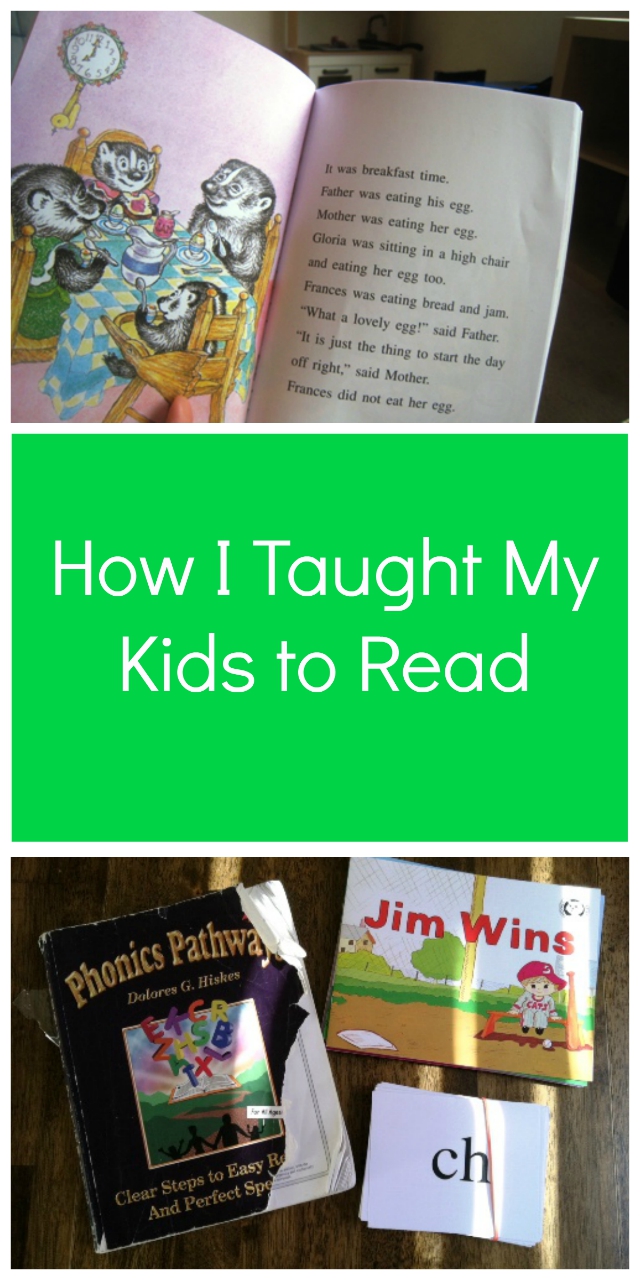
One of the things I was reminded of this past year in our Extreme Homeschool Makeover was that the basics are good. There’s nothing wrong with focusing on the basics. In fact, they are the building blocks to learning — and to the love of learning.
If a child knows and feels comfortable reading, writing, and doing basic math, he has what he needs to explore the world.
While I don’t expect my children to learn completely on their own, I want them to be able to explore their interests and preferences without waiting for me or a tutor to take them there.
Since FishPapa and I are such bookworms, it was imperative that our kids learn to read — and hopefully love it — as soon as possible.
No, none of my kids were reading at two. But, they were familiar with books, the act of reading, the connection of words to thoughts and little scribbles on paper, and thus far, all have taken off with reading around age seven.
In this homeschooling gig thus far, four kids have learned to read with a fifth well on her way.
How I taught my kids to read
I’ve been relieved that all four of my boys love books and stories. I don’t have any secrets. In some ways, I think I lucked out. Two of the boys practically taught themselves to read.
But, over the years, through MUCH trial and error, I’ve patched together a system that seems to work for us. It literally is a conglomeration of several different reading programs.
(Your mileage may vary.)
Want to save this post?
Enter your email below and get it sent straight to your inbox. Plus, I’ll send you time- and money-saving tips every week!
Reading Resources
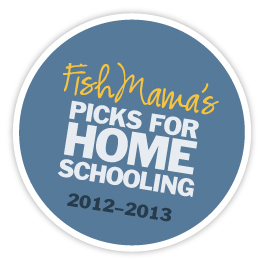
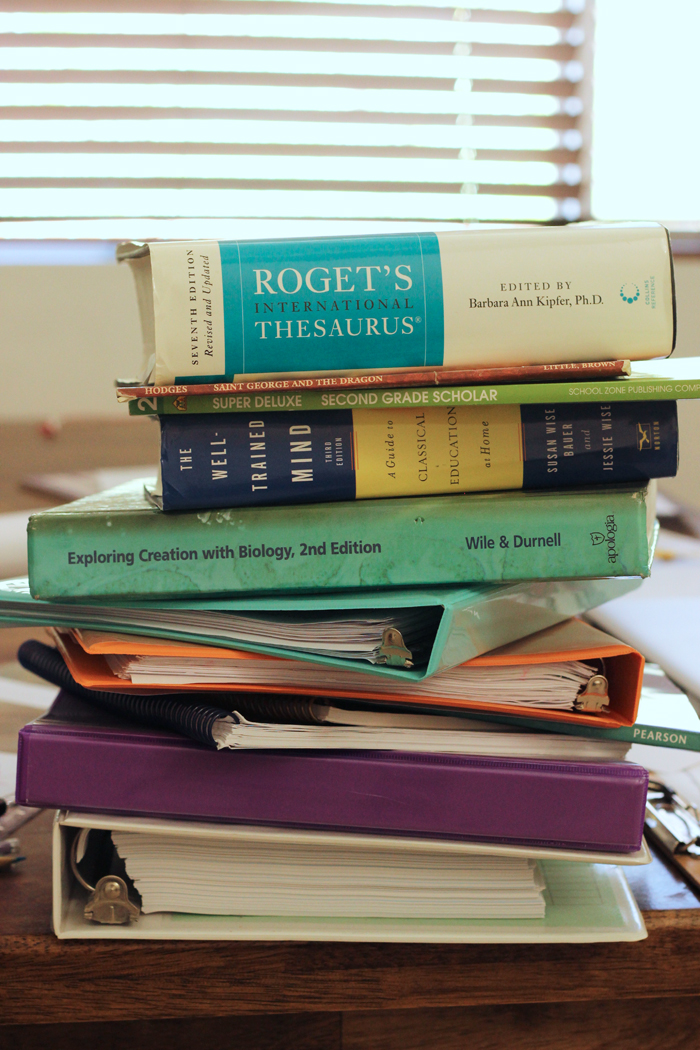
We started out our reading journey using Phonics Pathways by Dolores G. Hiskes, per the recommendation in The Well-Trained Mind. This is a very straightforward reading primer that gives the parent a script to read and sounds and words for the child to practice. I’ve used this book with all of my kids as they were learning to read.
Ours is a well-worn and tattered copy. I’m hoping it will last two more years, and I will thereby avoid having to purchase another copy.
While the book is designed to be a stand-alone text, I found that my oldest got really confused distinguishing between long and short vowels. Upon a friend’s suggestion we added the phonogram cards into our reading program in conjunction with Phonics Pathways. Within just a few months he was able to read far above grade level.
What are the phonogram cards? In the 1950s Romalda Spalding identified 70 phonograms (letters and letter combinations representing sounds) and used them in teaching reading. A number of modern reading curriculums still use the same phonograms in teaching reading.
At one point I invested in Spell to Write and Read, one such program based on the phonogram system. It’s an extremely complex program of drilling the phonograms and teaching children to read and write by learning to spell first. Friends have had tremendous success with this program. However, since I don’t read directions, it was just a little too complex for me to do properly.
And there’s the added complexity that reading, writing, and spelling don’t all gel in a kid’s mind at the same time. Some kids can read like college professors before they’re able to make the pencil do what they want. Others are expert calligraphers before the words on paper make much sense.
So, I took something out of the Spell to Write and Read program and tweaked it. Instead of following the program, I’ve had my kids memorize the sounds with me, using the flashcards.
Basically, learning the phonograms is learning all the possible sounds a letter or group of letters can make. Then when the child comes to an unfamiliar word, he remembers the different phonograms, sounding them out as he reads and experience (or you) helps him latch onto the right sound.
It’s like looking at all the puzzle pieces before putting them together.
Lastly, once the child can read simple three-letter words, we start real-life practice with some simple readers. I’ve bought several sets of Phonics Practice Readers by Modern Curriculum Press. These are goofy little stories written in the 70s, but are still in print today. My kids don’t mind and it gives them easy practice.
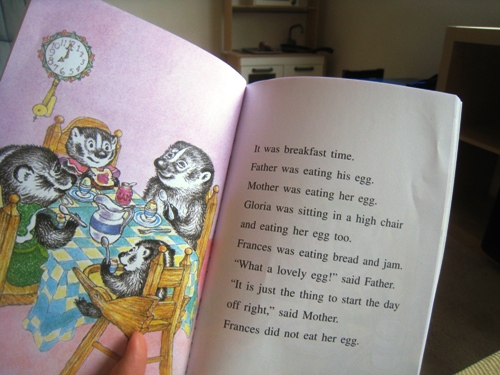
Since these are phonics based readers, your child won’t come across too many foreign, “sight” words. I like this since they can successfully read a book on their own and build confidence in real life.
My weird method in a nutshell
- Learn the sounds of the phonograms yourself so that you can explain to your child the different sounds a letter or group of letter makes.
- Begin to drill the phonogram cards with your child, starting with the vowels and then the single letter phonograms. As she masters those, add a few cards in every week or so. There is a vague numbering system on the back of the cards, and a more complete list in Spell to Write and Read, page 221. It’s not a big deal if you don’t do them in a special order. Just try to do the easy ones first so your kid can build confidence. Spend a few minutes every day flipping through the cards. Play games with them to mix up the activity. Talk about them when you see words throughout daily life.
- While you are still practicing the phonograms, start working through Phonics Pathways. The book starts with only short vowel sounds. I remind my kids that the vowels make several sounds, but we focus on the short vowel sounds .
- Once a child can read three-letter words, start daily practice reading a real book, like the Phonics Practice Readers by Modern Curriculum Press.
Mine is certainly not the only way to teach reading. I’m sure there are many, many better ways.
But, this has worked for my kids and me. I feel honored by the privilege of being their first teacher.
Other parents have had great success with Teach Your Child to Read in 100 Easy Lessons as well as The Ordinary Parent’s Guide to Teaching Reading, but this weird hodge-podge way of learning has worked for us.


I do have a question though, my 9 year old still occasionally writes her d’s and b’s backwards. Is this normal or should I be concerned?
I think I read that that’s considered normal until about 10. Phonics Pathways has a bookmark or something with the word “bed” written in large letters to look like a real bed. The sounds of that word can help them remember which is which.
I do not homeschool, but have always read to and with my daughters. Now our 6 year old is reading beginner books and has just earned her own library card. I think encouragement and consistency are key. Also, keep reading to them even after they can read and have them read aloud also. Our 9 year old daughter comes into the 6 year old’s room for storytime, as do our 3 cats.
We started with the Leapfrog DVDs before he was two. When he was three, we played with letters and one day he just put them together into words. We used the BOB books and the Now I’m Reading books (love those) for good Phonics practice, and learned sight words as we encountered them. I was definitely learning along with him! At 5 he now reads at about a third grade level so I guess we figured it out. I may need something more structured to help me focus on the right skills with my second son. We’ll see.
Yay! The post I have been waiting for! Thanks so much for sharing your “weird” method. I’m just starting on my homeschool journey, but I imagine I will have some “weird” methods as well. I have been using the Ordinary Parent’s Guide and the Bob books (thank you Costco) for a few months and they’re both working well for us. Starfall has been a very valuable resource for us as well – gotta love those catchy little tunes! (The silent E at the end of the word, end of the word, end of the word…)
Hearing my daughter read has been one of the most rewarding experiences of my life. I’ve blinked back a tear or two listening to her work through a tough word.
I appreciate this blog so much, Jessica. Our choice to live a little differently here in Scottsdale, AZ (What the what?!? Debt free!?! Homeschool!?!) is sometimes a little lonely, but you definitely inspire me to persevere in my choices. Thanks for that.
Aww, thanks for your kind words!
Thank you for sharing this. My son is reading some on his own and is now learning the more complicated phonograms and letter combinations and sounds. I have him read to me daily as I do not want him to lose his progress over the summer. I just was not sure how to help him move forward. I will use some of your tips for that!
Thanks for sharing this! My 6 (closer to 7 now) year old son hasn’t been interested in learning to read, despite his love for books and being read to. I’m planning to focus attention on the learning process thru the summer and see if he gets it. I think he already does (like you said with your boys that just seemed to get it) and is playing mind games with us, but maybe that’s a bit on the paranoid side, lol!
My youngest boy just turned 8. A year ago he claimed he couldn’t read. But, once we started school in August, I realized he had all the skills, just wasn’t sure how to put them together on his own. Within a few months he was reading chapter books on his own.
The same thing happened when he got some Magic Treehouse books for his birthday. He assumed they were too hard so he didn’t try. We read one page together, his reading and my pointing. And he was convinced.
I love all that you wrote about! I would definitely add that at about 1st or 2nd grade, adding in a set of flashcards of high frequency words. Words that cannot necessarily be sounded out (Thank you English language) but when memorized, help make a difference in a child’s fluidity.
That’s a great point. Thanks for chiming in.
Commented before on TWT post, and since then have also read the “The Read Aloud Handbook.” With my 11 month old we are having fun doing read alouds. I close the door to her bedroom and spread out some toys for her to play with. I read aloud for about 10 minutes from a children’s bible or a book I can finish in about ten minutes. She plays and checks in on me every now again. It still feels ‘odd’ to me to be reading aloud, but I must admit I enjoy it for myself. There are also some really great apps that read to the child and highlight words across the page to help them track. I used to love reading and then fell out of the habit in late high school/college. It’s been fun to jump back in! 🙂
How fun! It may not seem like you’re doing anything or that she’s getting it, but you are teaching her. A book rich home is great!
What is the book in the first photo called, with Gloria and Frances? I can remember these from when I was a kid and have been trying to figure out what they were.
That is one of my very favorite books, Bread and Jam for Frances. I read the Frances books as a kid and now we read them together. Love it!
Hooray!! Thank you so much. I’ve been trying to figure it out for a few months. You just made my day 🙂
I bought “Bread and Jam…” based on your recommendation and my children love it, as do I! Such a cute story I never had the pleasure of knowing as a child! My daughter has already asked for another book in the series!!!! Thank you so much!!!!!
Fun! Best Friends is good, as is A Bargain. Love them both. I need to buy our own copies of those.
Starfall seemed to do the trick for us… Starfall and the original Leapfrog dvds (“The A says Ah, the A says Ah”). Also apparently my habit of running my finger under the words I’m saying may have contributed.
Starfall is a great one! My 8yo was really upset earlier this year when his younger sister started correcting him on his sounds because she had learned them on Starfall. It was hilarious.
Thanks for making that point!