
How We Saved Money on a New Washer and Dryer
As an Amazon Associate I earn from qualifying purchases. For more details, please see our disclosure policy.
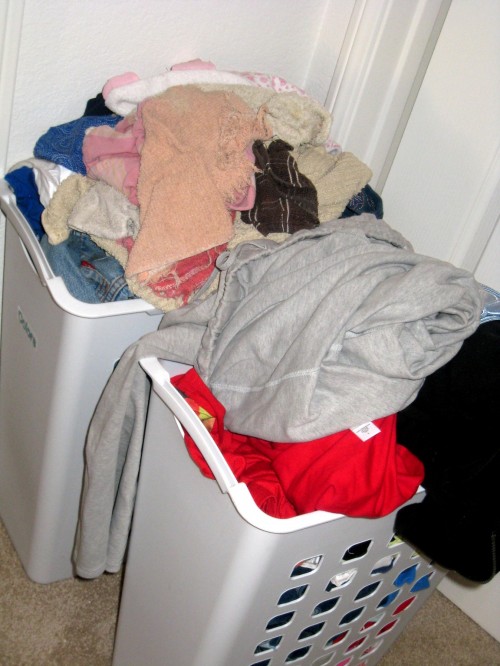
See this? This is HALF the laundry that was generated in my household in the last week since the dryer broke. The washer and dryer were on their last legs and decided to die in my absence. Right on their heels went the radiator and thermostat in our van. And the cam sensor. Whatever THAT is. My poor husband never let on that the supply of clean clothes was dwindling and that he had no way to transport all six children anywhere. I guess that explains the panic he might have felt when I almost missed my connecting flight in Phoenix. What a guy!
Do you know how much dirty laundry is created in five days’ time?!
Thankfully, I did get home at the prescribed time. And we spent Monday picking up the pieces. FishPapa called around town to get quotes on a new radiator for the van and off the van limped for repairs. Meanwhile, I hopped online to find a new laundry combo.
Here’s what I considered in my decision:
- What’s the going rate? We had previously researched front loading, high efficiency machines and realized that for the money, we probably weren’t going to get a much longer-lasting washer and dryer than your standard, old school, top-loading washer and standard dryer. We do a lot more laundry than the average household. We quizzed a repairman about this and he concurred. Plus, I just couldn’t swallow the idea of dropping $1,600 to $2,000 on laundry equipment. Instead, I looked up the going rate for your basic Whirpool combo which was about $1,000 after taxes.
- What’s the best cash back? I checked with Ebates as well as ShopAtHome to see who had the best cashback percentages for Sears, Home Depot, and Buy.com. Turns out ShopAtHome was offering 5% back at Sears as well as a coupon code for $5 off a $50 purchase.
- What kind of sales and rebates are going on? Clicking through to Sears, I found out that Sears had multiple deals going on, including 15% off all washers and dryers, a free delivery rebate, and a $50 rebate on each appliance.
- What’s the energy cost? We compared the energy costs of the basic Whirlpool washer and dryer to the Energy Star combo. Since we know that I do an average of 12 loads of laundry per week, we know that a w/d combo will not last as long at our house as someone else’s. Our last set lasted us 5 years. So, after some computations, we realized that the extra cost of the Energy Star machines did not pay for itself. (And before any of my green friends hassle me about buying the bargain machine, can I say that my thermostat is set at 64 degrees in the winter? We are doing our best to conserve energy in other ways. 😉 )
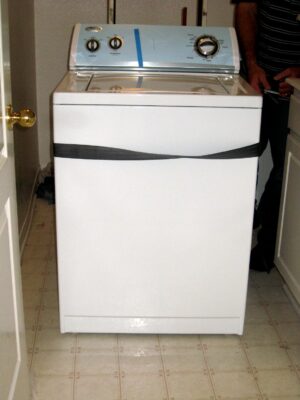
- Can I just stay home? In former times, I might have been concerned about seeing the machines in person and checking out all the bells and whistles. But, experience has shown me that the bells and whistles are just that — a lot of noise. They normally aren’t all that they’re cracked up to be. I read some reviews and was satisfied that basic was going to work for us. Normally, I would have said no to delivery since we own a truck. But, that gas, time and effort still costs us something. Being open to delivery proved to save us a lot more money since it was FREE!
Cost of washer and dryer after taxes and delivery fees: $933.89
Delivery rebate from Sears: -65.00
Appliance rebates from Sears: -100.00
Cash back bonus from ShopAtHome: -39.70
Coupon from ShopAtHome: – 5.00
Total Spent on New Washer and Dryer: $724.19
When all was said and done, we saved over $200 purchasing our new set, without even leaving the house. And it turns out that there were a few bells and whistles thrown in for good measure, like “wrinkle shield” and “energy preferred” settings. I spent the better half of Thursday whipping through 10 loads of laundry. I think these new machines work faster than the old ones.
Best of all, we’ve got clean clothes!
Edited to add: There’s been some great discussion in the comments regarding HE machines. Just to clarify, my point #4 above was comparing the energy savings of a basic top loader and the “Energy Star” top loader. I am not questioning the efficiency of the HE machines, but we had already made the decision not to spend 2K on the set.
So, looking at the lower price point machines — the top loaders — that was the conclusion we were making. It didn’t pencil out to pay $150 more to get a fancier top loader. I apologize for any confusion I might have caused.





AWESOME job!!
Thanks so much for this post. We used to have a front loader in our last house and I loved it (except for washing diapers), but when we moved our new place has a basic top loader, and I’m not entirely sure we’ll go back to a front loader, I love that I can wash more in each load. I think for us price vs options will probably win for us as well when we need to replace.
Thanks for sharing all this information. I have one question about the warranty. Did you choose to buy one? If not, why not? Just curious, is all. We purchased a Maytag washer from Fry’s Electronics about 5 years ago and opted for the warranty for an extra $50. It expires this year and we’ve had to use it about 4 times over the last 5 years. I’m guessing we’ll be due for a new one this year. What happened to the washer and dryers and fridges lasting for 20 years? My Momma’s fridge lasted 20 years, through 10 moves and repainting.
I thought that I was the only crazy person who set the thermostat so low! Ours is on 63! Honestly, it was a decision not to spend so much on our utility bill – I wish I could say that I did it to conserve energy.
I think the issue of whether or not to spend more on a high efficiency washer and dryer is a hot one. We have an HE washer and dryer and I give talks on home energy savings. I’m wondering if in your energy calculations you considered the following:
– The HE washer spins so much more water out of the clothes than a top loader that we run the dryer for a fraction of the time we used to and we often do not put sweaters, fleece items and cloth diapers in the dryer because they come out so dry it’s efficient to line dry or lay them flat. This saves both time (in the dryer) and money (because the dryer is run for much less time.
– The HE washer uses much less water, so our water usage bills are down.
– We wash predominantly with cold water, but if you still use warm or hot, the less water also saves on water heating bills.
– The HE washer uses significantly less detergent. You don’t actually have to use special detergent, just a lot less of your regular, so you buy 25%-30% of the detergent you used to buy.
– The front loaders are much more gentle on the clothes with the tumbling action vs the agitating of the top loader, so your clothes and towels, etc, look nicer and last longer (esp important if you pass them down between children).
All of the these things save you money, which I understand is most important to you. They also benefit the environment, using less water, putting fewer chemicals into the environment and using less gas or electricity.
I’m very surprised to hear you say that your washer/dryer only lasts 5 years, I hope you get twice that out of your new set, because that seems awfully short to me. I’ve had my set about 5 years, and while I’ve had the washer repaired a few times, it was under warranty each time and I expect to get several more years out of them.
I have 3 children (including one in cloth diapers) and I can’t imagine having 6. Good luck!
Alicia
We bought a new washer/dryer set about 4 years ago. It’s not a front loader but they’re bigger than normal capacity (in other words, I can wash anywhere from 2-3 “normal” size loads in just 1 load in the new ones). So, I wash about 4-5 loads per week, instead of double that. I don’t use my dryer a whole lot, I hang laundry outside most of the time. (I’ve had to use it more this winter, thanks to so much wet and cold weather). We had always had used washer and dryer sets up until then. Another thing we do is wear our clothes longer than 1 wearing (NOT underwear) and re-use towels and washrags for as long as we can. We have better luck at this in the winter than in the summer. We stay at home/homeschool so it’s a little easier. I have really enjoyed my washer/dryer (never had a new set and a matching one at that). I think we spent about $1,000.
I love that you talked about all the bells and whistles… because I think when we go out and shop for something we want something that looks nicer rather than what can do its job! 🙂
I am really impressed at how much research you did – you’re right to evaluate the “energy efficiency” of your appliances. It ISN’T cost efficient for everyone, and I don’t think you should feel any guilt over that fact! Everyone contributes in their own way to a “green” earth.
I say great job! 🙂
I can’t believe you only do 12 loads a week! 🙂 I do more than that, and I’ve only got two kids!! Hhhmmm… Okay, so I’m going to hope that part of it is that we live in Colorado and wear more clothes than you guys. Am I just that inefficient? Something to think about!
Wow!! Great job!! Doing your homework definitely pays off!