
Teaching Love for Others
As an Amazon Associate I earn from qualifying purchases. For more details, please see our disclosure policy.
Want to save this post?
Enter your email below and get it sent straight to your inbox. Plus, I'll send you time- and money-saving tips every week!
Her future depends on what you teach your children.
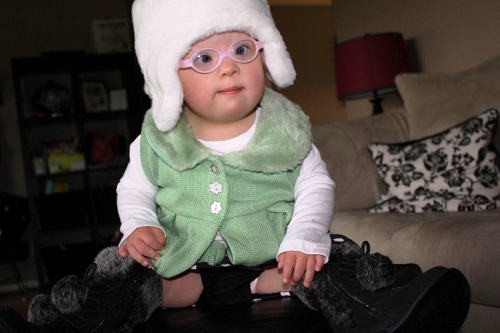
Down syndrome is a label that my daughter carries with her, not defining her or shaping her vivacious personality, but it is there, a silent part of her life, unfolding in unexpected places while remaining hidden in others.
Before Down syndrome entered my life, I was extremely uncomfortable around those that might be “different”. You know which ones I’m talking about: the greeter at Walmart who looks like something is not quite right, the man in McDonalds who is overly friendly in a simple way, the bagger at the grocery store who takes forever to sort a small cart of groceries.
Avoiding eye contact, allowing myself to become impatient when they didn’t perform their tasks quickly enough for my schedule, I would keep myself away from these “different” people at all costs. And when situations would bring them across my path, I wasn’t the friendliest I could have been.
Because they were different and I didn’t know what to say or how to respond.
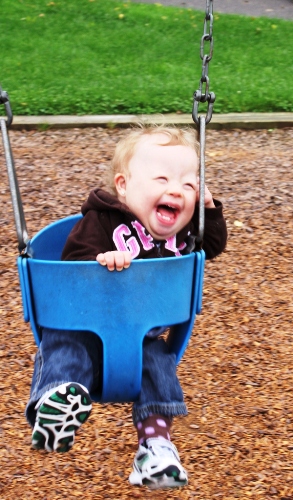
My daughter Addison is 20 months old — still a very sweet little girl whose delays and differences are easily glossed over by her age and absolute cuteness. But someday, perhaps she will be that lady in the store that you can tell something is not quite right. Perhaps it will be awkward.
Now that I’m on the other side of things, my perspective has dramatically changed.
Learning to love others despite our differences
With worries about my daughter’s future acceptance by her peers, you can imagine the joy I felt when my friend told me the following story:
She and her three year old daughter were visiting a friend that had just had a baby born with only one arm. The little girl proclaimed loudly in front of the new parents that if she had a baby with only one arm, she wouldn’t hold it.
My wonderful friend took this as an opportunity to educate her daughter. She explained to her impressionable little girl that just because this little baby had only one arm, he wasn’t any less of a person. Because she wasn’t used to seeing a baby with only one arm didn’t make the baby any less celebrated or special.
After that conversation her little girl warmed up to this little baby with one arm, and, by the end of their visit, was totally in love with this precious bundle.
It occurred to me then. Addison’s peers are going to play a large part in her future — and in the lives of other children with special needs.
They will determine whether the world is a warm, welcoming place to her or cold and indifferent simply because she is different. And Addison’s peers are those children being raised right now.
By you.
Seizing teachable moments
My friend could have shrugged past her daughter’s loud announcement, reasoning that her daughter was “just being honest.” Or perhaps that her daughter was too young to understand how unkind her statement had been. My friend could have easily apologized to the parents and rationalized away her daughter’s behavior.
But she didn’t. She educated her daughter in respecting all, not just those like herself. And in doing so, she inadvertently made a difference in my daughter’s future.
We have all kinds of things that we’re teaching our children: how to eat, how to dress, how to be polite, how to share…but are we teaching them how to accept those who are different?
How to treat someone who obviously (or not so obviously) has something “wrong” with them?
Doesn’t it start from early on when they notice a difference and loudly state their opinion? We parents have a choice to awkwardly shrug it off and apologize for the tactless comment…..OR to use the teachable moment to shape a young mind.
My daughter, who will always carry that title of “different”, just wants to be treated like any other little girl, to wear pretty things, to do fun activities, to have friends, to converse about what’s on her mind.
She is more like your children than different.
Getting comfortable with the unfamiliar
Oftentimes the reason we’re so uncomfortable around those with special needs is because it’s new or unfamiliar. We don’t know what to say or how to react because we’ve never been put in quite that situation before.
Be encouraged to make the unfamiliar not so awkward.
- Take your kids somewhere where they’ll have a chance to interact with “different” people and later talk about it, answering their questions and encouraging them about our commonalities.
- Teach your children that God doesn’t make mistakes, but that he designs each of us differently — and that is a good thing.
- Make it commonplace for them to see and react kindly to everybody.
- Help them see that “these people” are not people to be avoided at all costs, but a welcome part of their world.
Your kids are my daughter’s future. Please, please, please prepare them for life beyond the “normal.” Teach them how to react and respond and your children will make a positive impact on many through their loving acceptance.
Practicing kindness and love will make a difference in every child’s life. Who doesn’t enjoy a well-rounded person with a warm heart and a desire to make a positive difference in someone’s life?
Learning to accept these differences graciously will enrich every child’s life.
October is Down Syndrome Awareness Month. People with Down syndrome deserve to be respected and treated kindly just as much as you and I wish to be. Let’s teach our children that the smallest act of kindness on their part can make someone else’s day…whether that other person is just like them or startlingly different.
Let’s make a difference for the different.
– You can read more about Deanna, Addison’s birth story and their life together at Everything and Nothing in Essex. Read Deanna’s previous guest posts on Parenting a Child with Down Syndrome and Can Your Baby Have Too Many Clothes?



thanks for this beautiful article! i am teaching a parenting class tonight at church and i am going to open class with this article. we are exploring how to teach our children’s hearts. thanks so much! love your blog!
Loved this. Your daughter is adorable. I have a 13 yr old son with cerebral palsy. He has had some sad experiences with other kids, along with the good ones. I really think God was preparing me bc I had volunteered with people with autism and blindness in my teens and early 20s, so I never really felt uncomfortable. My son is I suppose what is considered moderately functioning, as he is able to walk with a cane and can do some self-care, and he is of average intelligence. So we are very very blessed. Sadly some people are mean and will stare, etc. On the plus side, his little brother (9 yrs old) has no hang-ups whatsoever being with people of differing abilities. As moms we all want the best for our children whether they are “typically developing” or not, it’s so important to teach all our children to be kind. hang in there! 🙂
Every child is a beautiful, perfect gift from God. You are so right – we need to be proactive in teaching our kids to be compassionate and understanding.
She is ADORABLE : ) You are so blessed!!!!
Beautiful post.
Oh my GOODNESS those pictures are cute. She looks so happy swinging and coming in for a hug!
Your daughter is very cute.
I am a mom of a special child myself, until recently you couldn’t tell by looking at her but at the start of kindergardern, she started getting the markings on her face and the kids started calling her gross. What helped was we explained the condition to the other children’s parents. Once they understood they were able to explain to their children and all is normal, whatever that is, again
Something I’ve seen happen at my children’s school more than once is a parent going into the classroom and helping the child [maybe Kindy is too young for the kid to do it LOL] explain to the class about some unusual thing that’s happening – whether it be something like the markings or a special need device or a particular behavior. One mom explained Asperger’s to my son’s class – which helped them all get along better with HER son. One went in to help her dd explain why she had special microphone equipment to help her learn with her auditory processing disorder. Stuff like that 🙂 The kids are always very receptive to it. So glad the parents helped out with this for you and your dd!
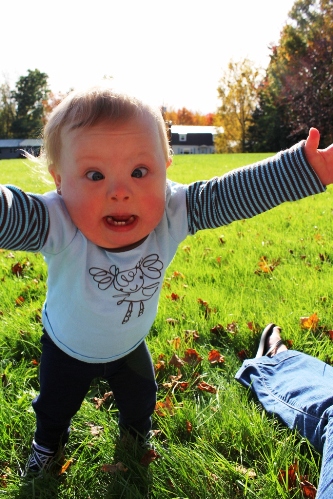
OK, first off, the picture with the stripey sleeves had me HOWLING – your daughter is so dang cute!
Great article. Really. But I wanted to point something out to you that I’ve noticed with my children [now 8, 11 and 13] that is very different from MY upbringing and experience as a child [as I got older I volunteered often in situations with ‘different’ types of people and learned so much more than I’d ever had the opportunity to earlier and my comfort level increased tremendously].
My kids are in school with all kinds of children. There are wheelchair-bound kids. Kids with braces on their body. Kids with autism and many other kinds of special needs.
And you know what? My kids don’t think of them as their ‘difference’ – they have always just thought of them as “Susie” or “Kate” or “Peter.” And sometimes they may explain to me that this particular child has special needs and that’s why they had different spelling words, or needed help from someone, or had a ‘special’ job. And the times they have spent being a ‘help’ to one of those children are always looked upon as positive experiences where they feel more connected to the child and feel good about being able to help someone. But mostly they just think of these children as kids – part of their world like everyone else.
So I see a VERY bright future for your daughter – not just because she has such a loving and supportive family but because the world she is growing up in, while not perfect certainly, is so much more open to ‘different’ and most of her peers will be able to appreciate the ‘special’ in special needs.
That’s really incredible! I hope that is becoming more the norm in schools today! I can’t tell you how happy that makes me. (-:
I wouldn’t have known it if I hadn’t heard it from my kids – so I’m glad I shared 🙂 It’s really a different world – try to reach out to the school community early – we even have a separate PTA that just addresses special needs called SEPTA [special education parent teacher assn] – several of my friends are involved with ours – it has helped them connect too – here’s a link to the PTA page about starting one [your area may already have one!] http://www.pta.org/3455.htm
I want to echo Cherie’s comments. I find the attitude of my (teenage) kids and their peers to be much more welcoming than those of my generation. I can only imagine how much better it will be by the time Addison is older. My cousin’s son — who also has Down Syndrome — was crowned Homecoming King at his high school. The way his classmates embraced him was so inspirational. Thanks for sharing your story.
This piece is beautifully written, and I will carry it in my heart forever. Thank you so much for sharing your story and lessons. 🙂
Thanks for this piece, I nearly spelled that ‘peace’. This really matters. I’ll do my best to bring up my little one so that both our little ones could be friends in the future even though they might live thousands of miles away.