
Homeschool Grammar Curriculum
As an Amazon Associate I earn from qualifying purchases. For more details, please see our disclosure policy.
Grammar matters. The study of language usage helps us communicate effectively in English as well as other languages. Check out these options for homeschool grammar curriculum.
There’s no one-size-fits-all when it comes to homeschool resources. It may take some trial and error to find the right fit for you as the teacher and your kids as the students.
Want to save this post?
Enter your email below and get it sent straight to your inbox. Plus, I’ll send you time- and money-saving tips every week!
Grammar? Why do we need grammar?
Because we do?
Because it’s what we’ve always done?
Because Abraham Lincoln knew a gerund from a present participle?
Because I said so?
Trust me when I say that these reasons won’t fly well with your children — or your gut. It’s downright silly to require your kids to learn something that has no purpose in this world. So, if you don’t know why you’re teaching something, you better find out.
Unfortunately, that’s what people think about grammar; that it serves no purpose in this world.
In my teaching credential/Master’s program at UCSB almost 30 years ago, my professors claimed that the study of grammar was obsolete. The education program as a whole did not encourage the teaching of grammar at all, neither did the public school where I later taught.
The study of grammar was relegated to the ranks of old school teachers who “should be retired already”, complete with eye rolling by those more hip educators.
Ironically, the eye rollers had the advantage of understanding how the English language works, thanks to their own grammar instruction, so they really had no way to A/B test what life would be like without it.
Grammar matters.
In my gut I’ve known that grammar was a good thing.
As a French major, grammar mattered tremendously in the acquisition of a new language.
As a French major, I learned that grammar mattered tremendously in my acquisition of a new language. So did phonics.
The parts of speech are, in fact, the building blocks of languages: English, Spanish, Japanese, French, German, etc. They basically tell you the job that a certain kind of word does in the sentence. And to communicate effectively we need to put words to work in the way they function best.
Grammar, at its simplest, is the study of the words in a language, the jobs that they do, and how to use them together in the most understandable way.
The argument my college professors used for dissing grammar was that we intuitively know when to use which words. They claimed that with abundant reading, a child would develop an ear for the right way for things to sound, that we don’t need to formally teach it.
However, in this global society that we live in with multiple languages being spoken, written, and read in one neighborhood block, I think this is less likely to happen for the masses, let alone the kids in our own homes.
I help my three year old learn to say “I can do it,” instead of “Me do it.”
In order to acquire fluency in a language — whether foreign or our own — an understanding of the jobs that words do is helpful. Not only does this help us use the words correctly, but it also helps us correct our own errors in writing and speaking.
Grammar helps us communicate better in our own language as well as acquire fluency in other languages.
Homeschool Resources
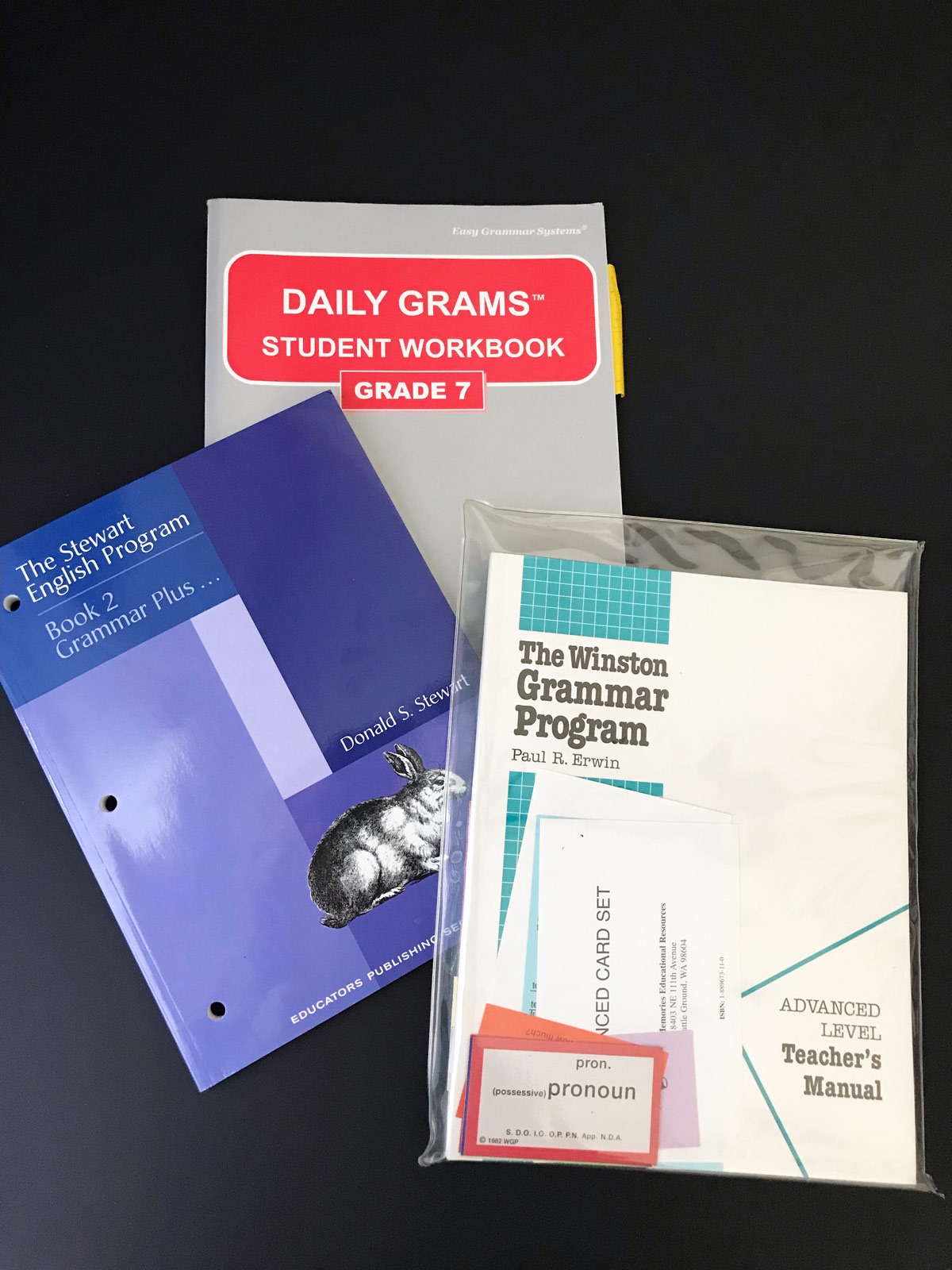
Over the years we’ve used several different homeschool grammar curriculums. Here’s a brief review of each:
Easy Grammar
We started out using Easy Grammar when my oldest was in 1st or second grade. At that time, I had four or five kids, mostly preschool and below, so let’s just say that I was in “survival mode”.
While I knew grammar was an important subject to teach, the baby daze was too overwhelming for me to sweat it too much.
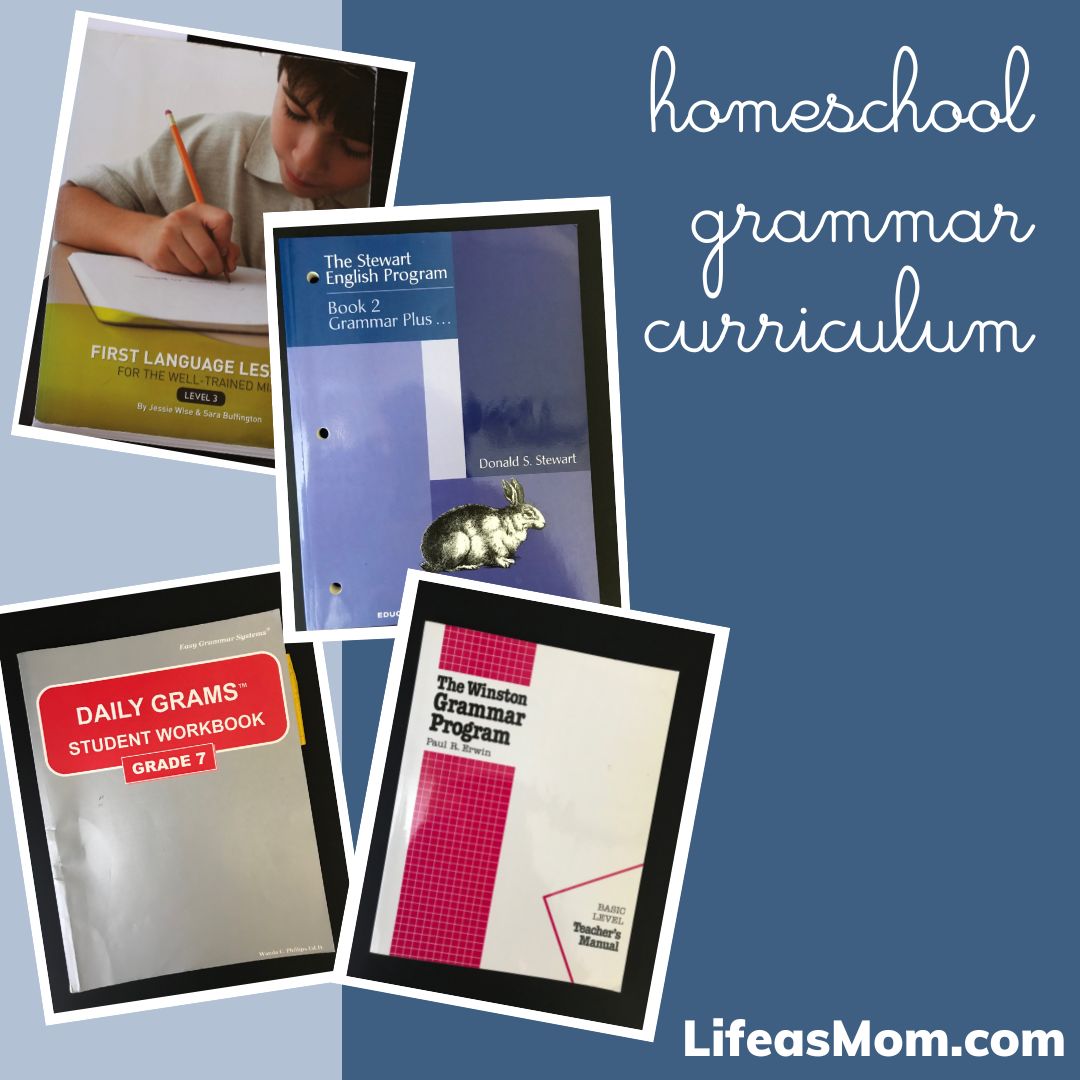
Easy Grammar, particularly the pink book was, indeed, an easy way to talk about the basics of language usage. My older boys did a page or two per day up into the middle grades at which point I realized that they didn’t completely “get it” when it came to articulating the jobs words did.
It’s about this time that the baby haze cleared and we switched programs, though in the junior high years we have returned to the grade level Easy grammar student workbook for review.
Winston Grammar
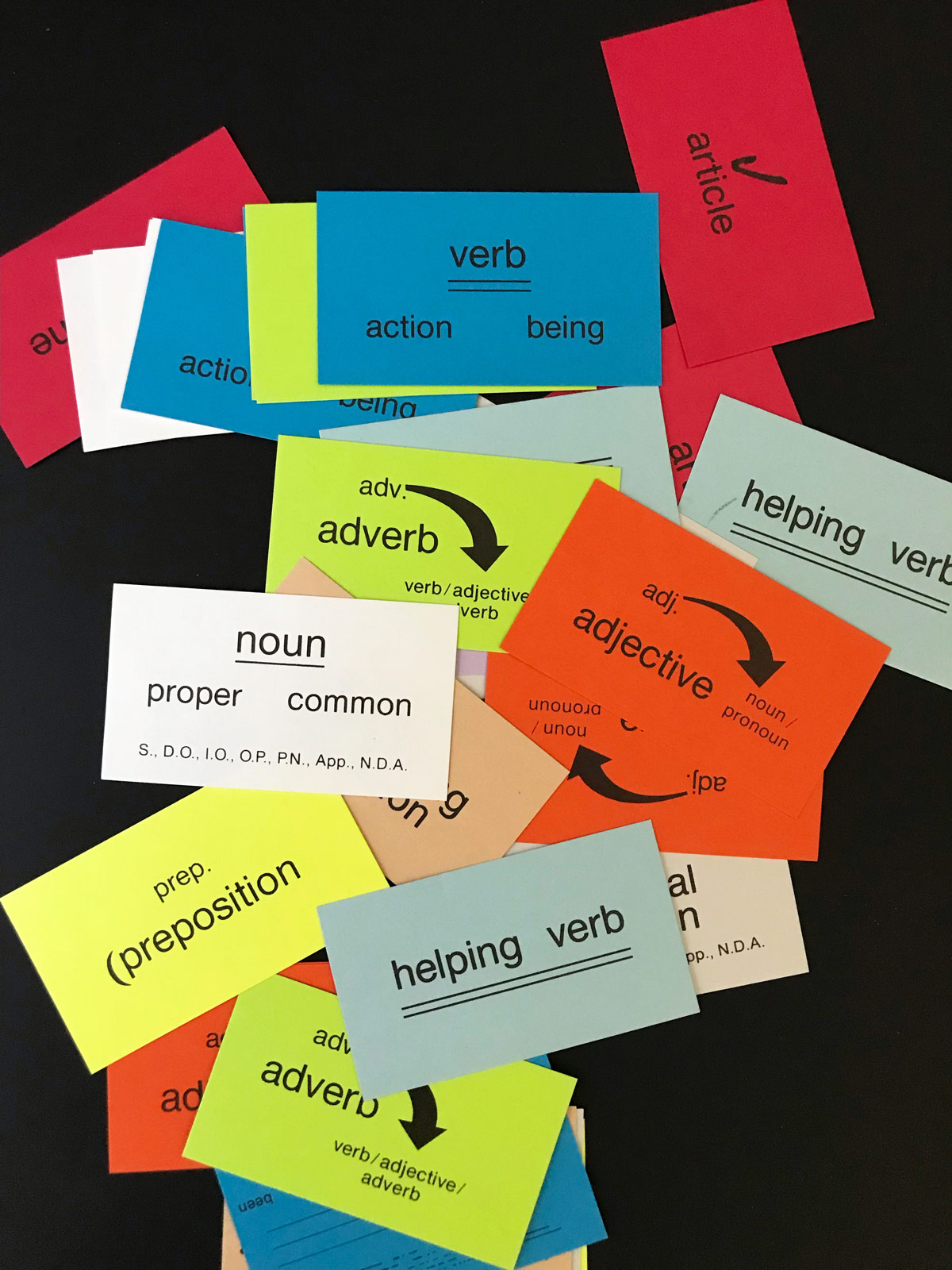
This is a very hands-on program in that flashcards are used to teach diagramming and the parts of speech. I liked this aspect of the program since it was very visual and kinesthetic.
We plugged along for both the Winston Grammar Basic and Advanced Programs while I used a different program with my younger kids. By using two different programs at the same time, I had a great experience of comparison.
I found that the other homeschool grammar curriculum was giving ME an excellent refresher course in grammar while I was almost as confused as my bigger boys with Winston Grammar.
While leads me to my best pick for grammar:
First Language Lessons
This homeschool grammar curriculum is repetitive, but that is a good thing. Teaching it helped me grasp a lot of things that I didn’t previously understand about grammar — and my own schooling included weekly grammar instruction for all 12 grades!
The program uses songs, poems, and stories to teach not only grammar, but also basic language and writing skills. I wish we had started with the first level book with all my boys, but better late than never!
I’ve used First Language Lessons for kids much older than it was designed for as a way to review and fill in the gaps. I recommend it for use between grades 3 and 8, with the caveat that some of the lessons are targeted for younger kids.
Other programs we’ve tried
Rod and Staff Grammar – This is very old school grammar curriculum and highly technical. I didn’t find it to be as practical as other programs.
Stewart English Program – My high schoolers take literature classes through an online classical school that uses The Stewart English Program. The workbooks are very user-friendly and cover the basics.
FAQs
There are myriad ways to set up your homeschool. It can be as much alike or different from a public school structure as you like. However, subjects required by your state of residence must be taught in your homeschool.
It really depends on you and the student. Some kids thrive with workbooks, while others do better with tactile learning items such as flash cards or games.
Formal grammar instruction can be started as soon as a child is reading fluently.
Grammar doesn’t have to have a bad rap. It’s amazing to me that it has in the past. But, words are so important. And when we use them effectively, we communicate so much more.
And I want my kids to be good communicators, don’t you?
More Homeschool Tips

What works for you?
Leave a comment below and let us know what works for you.
This post was originally published on July 3, 2012. It has been updated for content and clarity.



Sorry for 2 comments, but I should add that I’m going to try First Language Lessons again when my #2 kiddo is in first grade. I think it will be right up her alley. She’s a totally different type of learner than my oldest.
I was just going to comment on your first comment. Isn’t it interesting how different kids are?
It is interesting! And this leads to my problem of not being able to sell/giveaway curriculum that doesn’t work for us. I always think that *surely* one of my other 3 could use this so why give it away?!
I tried First Language Lessons with my 1st grader and it just was NOT a good fit for him. The repetition drove us both nuts. Good concept, just not the best for us.
We’re trying Easy Grammar this year for 2nd grade. He’s done a few pages over the summer and the style really works for him. It is repetitive, but introduces concepts frequently enough to keep his interest.
I’ve gone back and forth between these two curriculums. Which one would you say can be learned more independently. I have older kids, and a couple younger kids that take more of my time. I want something my older kids can work on their own as much as possible.
No wonder no one seems to be able to speak correctly! I had no idea they weren’t teaching grammar anymore. We’re about 95% leaning towards homeschool. This is a very timely series for me deciding what to do if we do stay home. It’s funny because I kind of decided kindergarten would be all about grammar and learning to read. Who knew I was so archaic?
I don’t know if this is widespread. But, this was the secondary education philosophy at my university. It may very well be different in other places.
No, that’s pretty widespread in teacher prep programs in the United States. The emphasis – at least, when I was a pre-service ESL / Russian teacher around 2006-2010 – was on whole language / Lucy Calkins-style Three Cueing / MSV “Balanced Literacy”, which de-emphasizes grammar, phonics, word meanings and so on.
We were instructed to emphasize students’ strengths and prior knowledge – such as a kid working with their dad to repair a car. This was intended as a means of promoting social justice, rather than use sound pedagogy to promote socially just access to English language instruction for ESL students. It was a major problem later for my ESL students.
When I taught in the schools, I was required by regulation to dumb down English language reading and grammar instruction for my ESL students, rather than help truly bridge the language gap. Meanwhile, we were expected to cram into their brains more academic instruction than they could retain, so they could hopefully pass state tests.
Our kids’ overall understanding of the English language was not that great, nor was their mastery of basic math facts. Teaching math facts was also de-emphasized, due to our math curriculum. Math facts were not even taught by some of the worse teachers, because it wasn’t emphasized in the math curriculum.
Later, when I taught French in high school, I was expected to teach my kids more terms than they could internalize in one sitting – and then some verb and / or grammar structure, after which the kids were to put it all together.
My teacher prep program did not provide us sufficient good strategies for me to do all of this effectively. Suffice it to say that I left teaching.
Around the 2019-2020 school year, when I started homeschooling, I discovered that this was a fairly widespread problem in American public schools – due to bad pedagogy – especially in reading – allegedly being espoused by the majority of teacher prep programs. Just Google “Reading Wars”. As a former public school teacher, I had actually never heard of the term. I just did what I was told – to the detriment of my students.
One I found found out about this problem of bad pedagogy – and that a Structured Literacy-style curriculum is said to do a better job supporting students’ understanding of the English language – I just stuck to my gut instincts on teaching, going back to my roots: spelling, grammar and vocab – both isolated and in context – that sort of thing. Strategies along those lines are more apt to support student learning than a curriculum that does not emphasize spelling, decoding, grammar, etc.
I grew up learning the real deal, and that’s how I was able to study Arabic, Russian, Chinese and other languages. It’s not a huge deal when you have a general working understanding of grammar. With regards to declension-based languages – such as Russian, German and even formal FusHa Arabic – studying another declension-based language – such as Latin – would likely help. If nothing else, understanding inflections – such as ending changes for subject-verb agreement, or to make a noun plural – can almost help explain the concept of declension, although direct and indirect objects – such as in French or Spanish – would help more. When it comes to languages whose word order differs from English, it is helpful to study a language whose word order is not the same as English. Languages such as Chinese are well-known for having a very different word order when compared to English. Russian word order can also differ – especially for emphasis, as word order can be more flexible in some situations.
Sorry for the long reply. Suffice it to say that I think teaching grammar is important. If nothing else, it makes you sound more sophisticated when you use their, they’re and there – or to and too – in proper context. I find it disheartening to see so many folks have no idea when to use which one. It is to me a testimony of the poor quality of their education.
I apologize for the length of some of my sentences. I was taught French when I was young, despite being American and enrolled in an American public school. I don’t mean to make some of my sentences sound like run-ons. I suppose, in restrospect, that I should address that issue. Hopefully, I’d find a text that would benefit both my kid and me there. It is, however, a bit of a cultural element at times in other languages.
I’m told the Brits favor concision. Perhaps I’d do well to learn from them.
Grammar is a must if you want to learn such languages as German, Latin, Russian, Swedish, etc… I didn’t realize at the time but I’m grateful to my french teacher in grade 9 that made us do a dictation of one sentence everyday and after made us analyse one word of the sentence. I understood a couple of years later when I began learning German (which is a declension language) how important it is in that language the function of the word in the sentence because the endings are different.
I’m probably a little older than you Jessica, but after grade 10, we didn’t make any sentence analysis, it was wiped out of the programs! I’m originally from province of Québec and same thing happened here as you when you were in college.
(I apologize in advance if I have made grammar mistakes in my post, English is not my first language, French is.)
I think you did great. 😉 I’m realizing that the tools my French teachers used to teach me a second language (dictation, copywork, etc) are super valuable in teaching my children their first one.
My husband is grammar lover (he thinks diagramming sentences is a blast) and it helped him tremendously when he studied Greek and Hebrew in seminary.
Jessica – is the Faith based at all? Not that I need a faith based language arts program, but just curious. Also – is this a whole language arts program? Or just the grammar part of it? Do you use a separate language arts program? Thanks for sharing! I was just getting ready to buy some Easy Grams for my kiddo, but wasn’t 100% sure what I wanted!
The only grammar program that I’ve mentioned that is specifically faith based is the Rod and Staff program. First Language Lessons encompasses grammar, narration, and copywork. Peace Hill Press has a separate program for composition which we’re going to start this year.
Also – is there a way to test your kiddos to see where they fall, so you know which book to purchase for them? I’ve got one going into 4th grade and I’m not sure which book I should be using!
I don’t think there is a placement test for that. But, I think jumping into the 4th grade book would be fine. My older guys are going to have LOTS of review in doing that, but I just want to make sure we fill the gaps.
One more question! Thanks so much for keeping up! Do you recommend ordering both the teacher edition and the student work-book in them, when you get to level 3? Just trying to figure out if I need both of them for this year 🙂 There are no very detailed reviews that I can find any where listing exactly what I need! Thank you again!
I teach in the public school system. We still teach grammar daily in my elementary school. Our problem isn’t that we don’t want to teach it, but our wonderful elected officials keep upping the standards. We are in the middle of a transition to new standards that are going to increase material difficulty. Some things that are currently taught in 3rd grade will be taught in 1st. This has made me wonder if I want to continue teaching and having my children attend public schools. I want to teach the old basics, not these new high level math and science standards. I want my kids to be kids not doing what I did in high school.
I love grammar! Thanks for this post. I’m a homeschooling mom of six as well.
Sorry my first comment on your blog is a correction, but grammar is not a French major. Since this post *is* about grammar I thought I’d point out this little mistake. It’s meant very kindly and with a smile! 🙂 Keep up the terrific work on your blog. I love it!
———
As a French major, grammar mattered tremendously in the acquisition of a new language.
Ha! Duly noted. How’s this? As a French major, I found that grammar mattered tremendously in my acquisition of a new language.
I think that since I know the grammar rule, I know how to fix the error you’re pointing out. Point made. 😉
Yes, that’s exactly what I would have done… and we all knew that is what you meant. 🙂
You’re ahead of me if you know the rule. I usually sputter something like “That thingie before the comma has to agree with the subject.”
I love grammar! I was exceedingly fortunate and had a teacher in high school who taught grammar. I loved it. In college, I majored in English and yet was usually the only one in the room (minus the professor) who could identify various parts of speech, types of sentences, etc. It has come in handy through the years as I’ve edited many of my husband’s papers for grad school and even had the chance to edit a book for a friend of mine. I want to make sure my daughter learns grammar, and am appreciative that you gave some recommendations. Thanks!
Oh, I’m happy to read this! I see why people may feel that “teaching” grammar is a waste of time that could be better used to teach other subjects, but I don’t think that people automatically absorb it. I also think it’s important. I hate seeing incorrect grammar, word usage, or the like; it causes me to stop and I lose the message of the writer, because I’m focused on the error (or what I think is an error!) I know it’s all too easy to make typos, but I really respect a writer who takes a moment to re-read their posts and comments and make sure that a grammatical misstep isn’t going to derail the delivery of their message.