
Homeschool Grammar Curriculum
As an Amazon Associate I earn from qualifying purchases. For more details, please see our disclosure policy.
Grammar matters. The study of language usage helps us communicate effectively in English as well as other languages. Check out these options for homeschool grammar curriculum.
There’s no one-size-fits-all when it comes to homeschool resources. It may take some trial and error to find the right fit for you as the teacher and your kids as the students.
Want to save this post?
Enter your email below and get it sent straight to your inbox. Plus, I’ll send you time- and money-saving tips every week!
Grammar? Why do we need grammar?
Because we do?
Because it’s what we’ve always done?
Because Abraham Lincoln knew a gerund from a present participle?
Because I said so?
Trust me when I say that these reasons won’t fly well with your children — or your gut. It’s downright silly to require your kids to learn something that has no purpose in this world. So, if you don’t know why you’re teaching something, you better find out.
Unfortunately, that’s what people think about grammar; that it serves no purpose in this world.
In my teaching credential/Master’s program at UCSB almost 30 years ago, my professors claimed that the study of grammar was obsolete. The education program as a whole did not encourage the teaching of grammar at all, neither did the public school where I later taught.
The study of grammar was relegated to the ranks of old school teachers who “should be retired already”, complete with eye rolling by those more hip educators.
Ironically, the eye rollers had the advantage of understanding how the English language works, thanks to their own grammar instruction, so they really had no way to A/B test what life would be like without it.
Grammar matters.
In my gut I’ve known that grammar was a good thing.
As a French major, grammar mattered tremendously in the acquisition of a new language.
As a French major, I learned that grammar mattered tremendously in my acquisition of a new language. So did phonics.
The parts of speech are, in fact, the building blocks of languages: English, Spanish, Japanese, French, German, etc. They basically tell you the job that a certain kind of word does in the sentence. And to communicate effectively we need to put words to work in the way they function best.
Grammar, at its simplest, is the study of the words in a language, the jobs that they do, and how to use them together in the most understandable way.
The argument my college professors used for dissing grammar was that we intuitively know when to use which words. They claimed that with abundant reading, a child would develop an ear for the right way for things to sound, that we don’t need to formally teach it.
However, in this global society that we live in with multiple languages being spoken, written, and read in one neighborhood block, I think this is less likely to happen for the masses, let alone the kids in our own homes.
I help my three year old learn to say “I can do it,” instead of “Me do it.”
In order to acquire fluency in a language — whether foreign or our own — an understanding of the jobs that words do is helpful. Not only does this help us use the words correctly, but it also helps us correct our own errors in writing and speaking.
Grammar helps us communicate better in our own language as well as acquire fluency in other languages.
Homeschool Resources
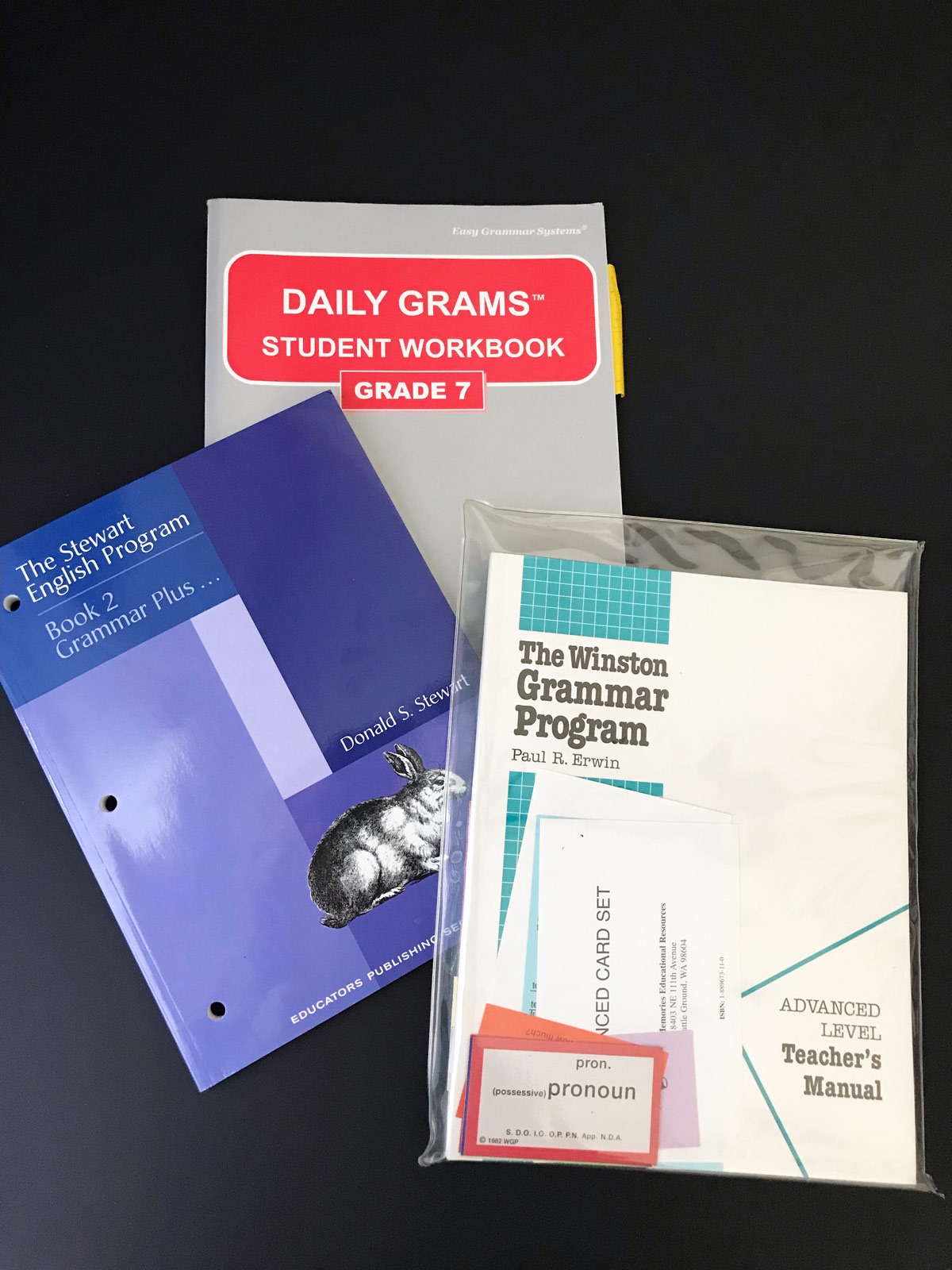
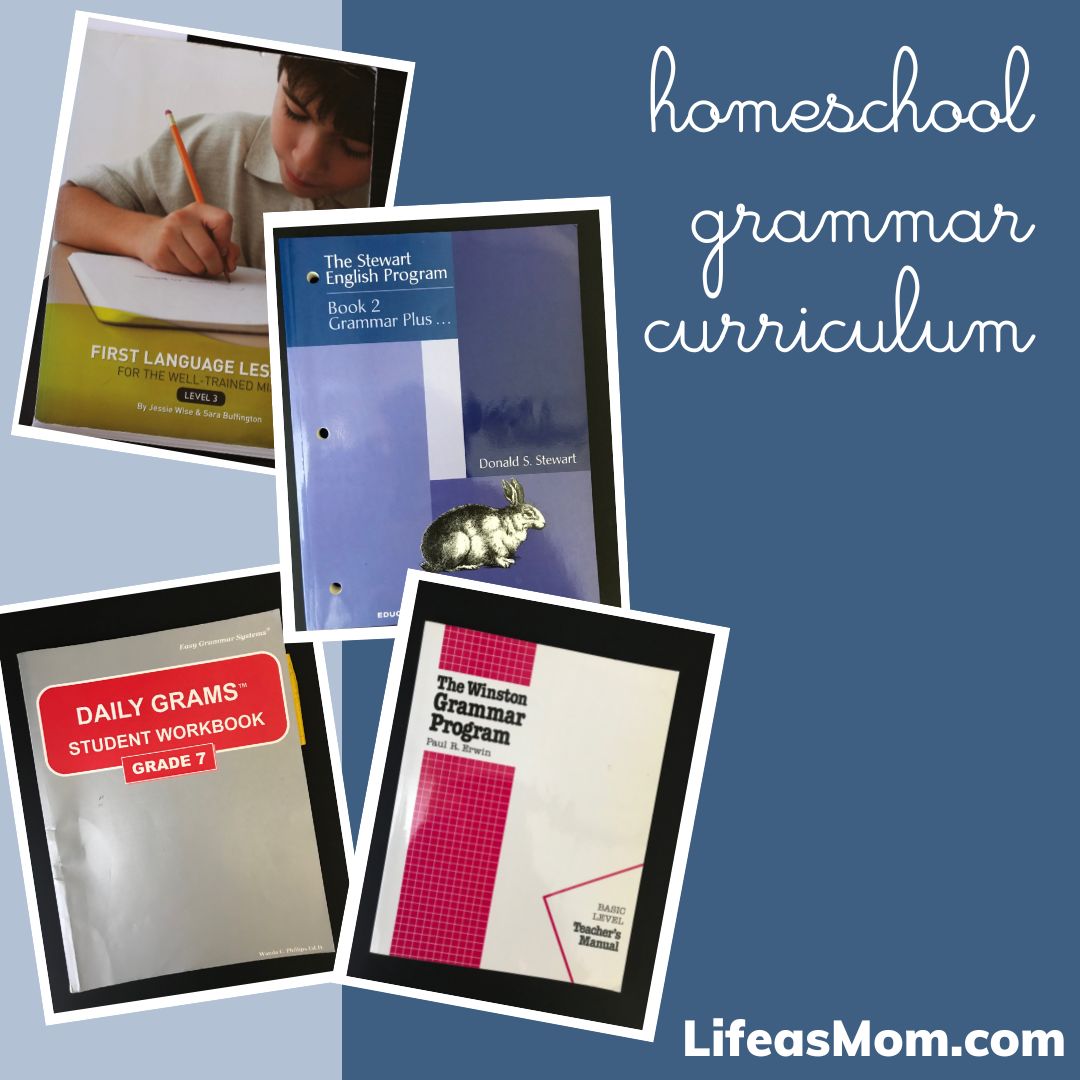
Over the years we’ve used several different homeschool grammar curriculums. Here’s a brief review of each:
Easy Grammar
We started out using Easy Grammar when my oldest was in 1st or second grade. At that time, I had four or five kids, mostly preschool and below, so let’s just say that I was in “survival mode”.
While I knew grammar was an important subject to teach, the baby daze was too overwhelming for me to sweat it too much.
Easy Grammar, particularly the pink book was, indeed, an easy way to talk about the basics of language usage. My older boys did a page or two per day up into the middle grades at which point I realized that they didn’t completely “get it” when it came to articulating the jobs words did.
It’s about this time that the baby haze cleared and we switched programs, though in the junior high years we have returned to the grade level Easy grammar student workbook for review.
Winston Grammar
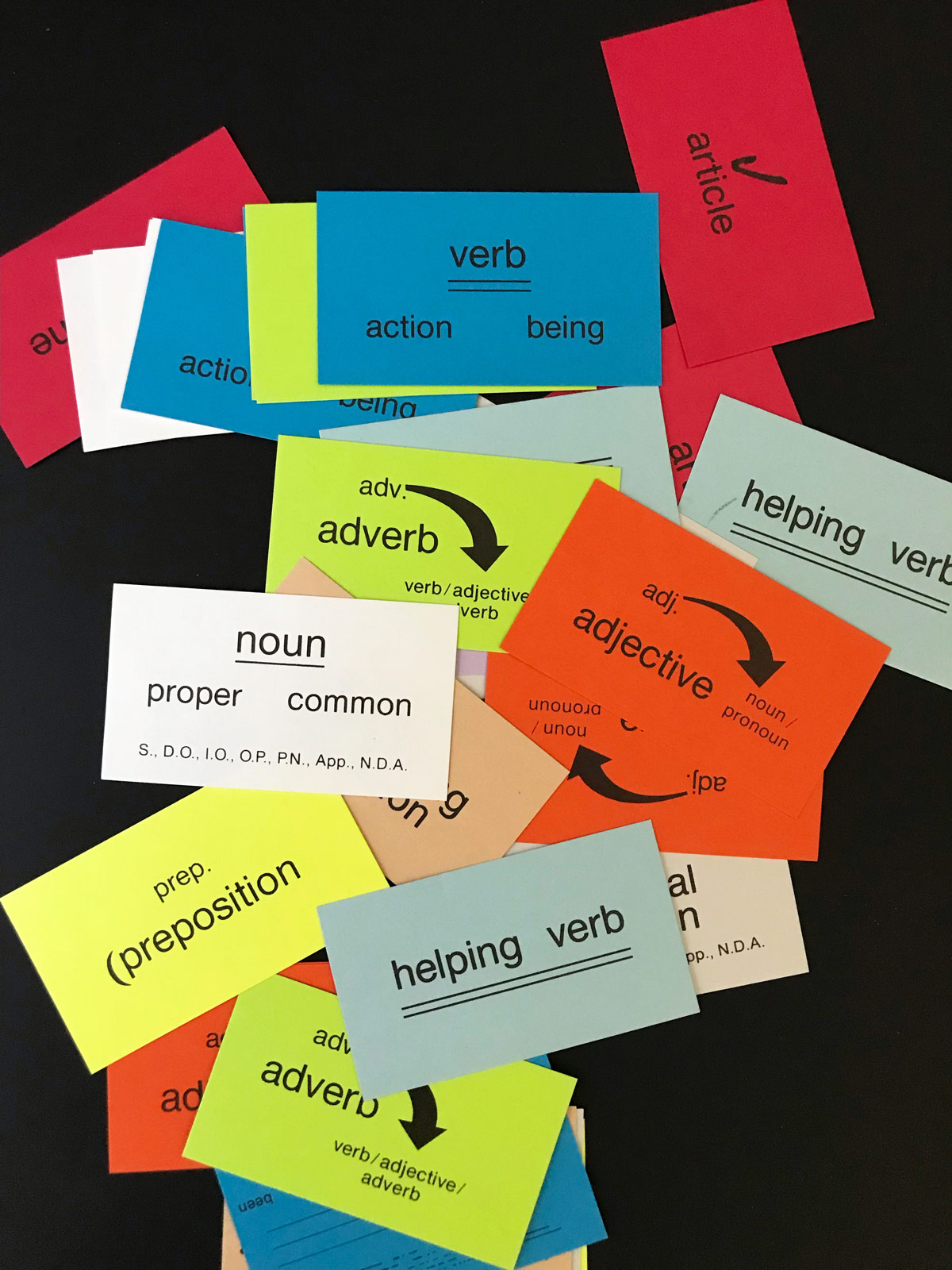
This is a very hands-on program in that flashcards are used to teach diagramming and the parts of speech. I liked this aspect of the program since it was very visual and kinesthetic.
We plugged along for both the Winston Grammar Basic and Advanced Programs while I used a different program with my younger kids. By using two different programs at the same time, I had a great experience of comparison.
I found that the other homeschool grammar curriculum was giving ME an excellent refresher course in grammar while I was almost as confused as my bigger boys with Winston Grammar.
While leads me to my best pick for grammar:
First Language Lessons
This homeschool grammar curriculum is repetitive, but that is a good thing. Teaching it helped me grasp a lot of things that I didn’t previously understand about grammar — and my own schooling included weekly grammar instruction for all 12 grades!
The program uses songs, poems, and stories to teach not only grammar, but also basic language and writing skills. I wish we had started with the first level book with all my boys, but better late than never!
I’ve used First Language Lessons for kids much older than it was designed for as a way to review and fill in the gaps. I recommend it for use between grades 3 and 8, with the caveat that some of the lessons are targeted for younger kids.
Other programs we’ve tried
Rod and Staff Grammar – This is very old school grammar curriculum and highly technical. I didn’t find it to be as practical as other programs.
Stewart English Program – My high schoolers take literature classes through an online classical school that uses The Stewart English Program. The workbooks are very user-friendly and cover the basics.
FAQs
There are myriad ways to set up your homeschool. It can be as much alike or different from a public school structure as you like. However, subjects required by your state of residence must be taught in your homeschool.
It really depends on you and the student. Some kids thrive with workbooks, while others do better with tactile learning items such as flash cards or games.
Formal grammar instruction can be started as soon as a child is reading fluently.
Grammar doesn’t have to have a bad rap. It’s amazing to me that it has in the past. But, words are so important. And when we use them effectively, we communicate so much more.
And I want my kids to be good communicators, don’t you?
More Homeschool Tips

What works for you?
Leave a comment below and let us know what works for you.
This post was originally published on July 3, 2012. It has been updated for content and clarity.





Hi Jessica!
Don’t know if you are still checking answers on this or not – but thought I would ask any way! lol. As per your suggestion, we have been using First Language Lessons for 2 yrs now. I have LOVED it! It is a fantastic grammar program, and my kids have all loved it. My oldest is finishing up level 4 this year, and since there is no more levels of FLL, nor will they be making any more 🙁 Wondering what you use these days after FLL is done? How is the Rod and Staff going for you? Do you feel that going from FLL to it was an easy transition? I keep looking at Easy Grammar, but I’m afraid that after FLL it will be to easy for her. Part of me wonders if we really need to do any further specific grammar lessons past level four of FLL. Any thoughts? Thank you so much for your time! I know it is very valuable!
I personally thought that Rod and Staff, while good, was a little more in-depth than I think is necessary. It had parts of speech I had never heard of — and I had a pretty in-depth grammar education. I felt it was just a little over the top. I did Easy Grammar for years, but there is really little instruction in the books, so it kinda fell flat for us.
I like Winston Grammar. It’s very hands on and what I used for my big boys since they missed the FLL wave.
My oldest daughter, home schooled and in high school, absolutely loves learning Japanese, with the goal to travel to Japan. Before the end of her first year in an online Japanese course she realized the value of grammar. In order for her to fully understand how the Japanese language constructs sentences, she had to understand English grammar, not a subject that she has enjoyed. Now English grammar is a subject she has a strong desire to better understand, not because she wants to understand English grammar, but so she can better understand Japanese.
Thank you for sharing your thoughts and insight!
Alyson
Thanks for this! Two weeks ago I realized that my my second and forth graders have never studied grammar! I am not sure if the school even teaches grammar anymore. I will be purchasing the level one book soon.
Also…..Analytical Grammar is FABULOUS!
I am curious how this worked for you this year? I have been using FLL and WWE with 3 of my kids this year and I find it to be very teacher-intensive and repetitive. I have found myself wondering if there was a way to simplify without loosing the richness of the curriculum. Thanks for sharing what you have learned along the way!
You know, I like it. Granted I’m going through four grammar books a day among five kids, so I’m definitely repeating myself. But, I’m thinking the repetition within the grade level is working. My kids seem to be getting it. I will continue with FLL 2 and 4 for those kids next year. Not sure what to do with the big ones for grammar yet.
As for the writing, well, the jury is still out. It is repetitive. But, I never took the time to read the main book for the WWE series. That could be my problem. Did you read the main book?
I did read it, and I highly recommend it. I really like the cirriculum (upon reflection, my comment before sounded very negative), I especially like the repition/review within the grade level. There have been a couple of times after MANY repeats that my daughter has said, “Oh, now I get it!”
There are so many similarities between grades, I wish there was a way to combine lessons and have individualized work of varied intensity. Also, I would love to teach the lesson and have them work through, rather than teach-work, teach-work, teach-work. I have six children (similarly spaced, but a few years behind you) As much as I like ‘holding their hand’ throughout, I am short on time to do so.
I read in a previous comment about combining multiple students to one level; maybe I will give that a try!
Oh, please excuse *loosing*, I really did mean losing! 😉
Please, overlook my poor grammar! *blush*
I hear you on all counts. And don’t worry about your grammar with me. 😉
I’m SO HAPPY I found your post today (via a google search)! Next year will be our third year homeschooling. My boys had no formal grammar instruction in their private school. I started my younger one last year with FLL level 2, and we are continuing with 3 this year. I love it and plan on using FLL level 4 next year with him. I used Growing with Grammar with my older son these two years (level 5 & 6), since I thought he was too old for FLL. While he is doing ok, I’ve been so tempted to switch him at various points, but have not mustered up the courage because I worry about taking him “back” so many levels. He would really benefit from the systematic approach to grammar that FLL has, though. Now that I see that someone else has used FLL level 4 with a 7th grader, I’m feeling better about this idea! Thanks for sharing!
Just don’t tell my 7th grader it’s a 4th grade book! 😉 Most of it has been very easy for him, but I am glad to have filled in the gaps to make sure he got the basics. Now to figure out what to do next year….
PS. Glad you found me, too. Welcome!
Thank you for writing this series. Due to an incredibly chaotic spring and summer, I’ve been a bit behind on school planning for the upcoming year. Looking back over these posts has been quite helpful.
We started Rod & Staff last year with our then second grader and he’s doing really well with it. He hasn’t finished English 2 yet, so he has been working on it over the summer. However, I’m not sure his younger brother, who will be in first grade this year, will do as well, so I’m looking into other programs.
Funny aside: My husband and I have a running grammar correction joke! If either of us fails to use an adverb in the correct place (ie. verb is used instead), the other will simply say “ly” after the word has been said! Realistically, both of us know when we’ve made the error, but it was too late to correct it when we realized it, so the other simply adds the sound we left out!
Ha! That’s great. Glad that these posts are helpful to you!
I’m not an English teacher or grammar pro, but I have a dad who’s very good with languages, so I grew up hearing proper grammar and even discussing infractions at the dinner table 🙂 It’s very important to purposely teach grammar. Especially with the advent of Facebook, blogs, texting, and easily-accessible internet articles, people are exposed to poor grammar, punctuation, spelling, and syntax on a daily basis. If you don’t teach your kids correct grammar and the other things that go along with it, they’ll probably absorb all the *wrong* rules from the general public. And even though we can speak/write correctly based on what sounds right most of the time, there’s always that odd situation where you don’t know what sounds right, or when the wrong thing sounds right! 🙂 Thanks for sticking up for good, old-fashioned grammar lessons! (And it’s rather scary to comment on a grammar-rules post–pardon any mistakes! Can’t take time to do a full edit 🙂 )
It’s totally scary to write about it! LOL
I had a teacher in highschool who was a stickler for proper grammer, punctuation, etc. Now I find myself being just as picky. As a public school elementary teacher, I have discovered that even though I teach grammar in my class, kids tend to write the way they speak. Thanks to technology, they are even turning in papers to me with “text lingo”, missing punctuation, and so on. I am glad to see that others find good use of grammar to be important. Not using it properly can really mess up what you are trying to say. I saw this in a picture posted on someone’s Facebook the other day, about the proper use of commas. Without a comma, “Let’s eat, Grandpa!” becomes “Let’s eat Grandpa!” I don’t think Grandpa would taste all that good anyway! Don’t get me started on forms of words, such as to, too, two/their, they’re, there/your, you’re…….
I’m the grammar stickler in the house. Not that I’m perfect or remember all the odd rules but my guys know what the raised eyebrow and an “excuse me” (especially if the eyebrow doesn’t work). I purposefully let dad “overhear” certain grammar lessons hoping the more common infractions can be tamed (subject/verb agreement, etc.)
Love Rod & Staff but the youngest couldn’t handle the diagramming with his concrete thinking issues (still an issue at 11). Although I can understand where you are coming from with Winston Grammar (chuckles at your description), it is a blessing for us for this kiddo in that he can “see” the cards to make grammar more concrete. No more tears! The cards are rarely used anymore, but if he gets stuck he knows to figure it out with the cards before asking for help– it gives him a visual for problem solving skills. I’m hoping to transition back to Rod & Staff when he can handle it.
I’m glad you posted this as I need to ask my oldest if he wants to do Advanced Winston Grammar or Rod and Staff. I do most of my grammar instruction through IEW composition but want to continue reviewing with a traditional text. I might edit my husbands papers and such, but I’m sure there are rules that I don’t remember.