
Setting SMART Financial Goals
As an Amazon Associate I earn from qualifying purchases. For more details, please see our disclosure policy.
Having money goals can be great motivation for earning and saving money as well as give direction in how you spend your money. But how do you set SMART financial goals?

Want to save this post?
Enter your email below and get it sent straight to your inbox. Plus, I’ll send you time- and money-saving tips every week!
Money can be a huge stressor for a lot of people, particularly for couples and families. It’s hard to live within your means and meet everyone’s needs.
When Bryan and I were dating, we were mindful of our money, but that mindfulness took a more serious turn once we got married and leveled up the more kids we had. When you are responsible for more than just yourself, there’s a lot more risk.
Managing money well may seem to come easy to some people and be harder for others. I think some of us are just more intuitive about earning, spending, and saving money.
Everyone can learn to manage their money well and acquire wealth. Part of that process happens in setting financial goals. These are key to debt-free living.

Why Set Financial Goals
Setting financial goals takes your fiscal life beyond just getting by. It’s the next level in the Game of Life, one where you can think bigger than paycheck-to-paycheck.
Sometimes you get knocked down, like when debt accumulates or you’re out of work, but getting back to setting financial goals can add purpose and motivation to your daily grind.
Setting SMART financial goals can make your future plans more effective.
Setting SMART Financial Goals
What are SMART goals? Likely, you’ve heard the term before; it’s an acronym for more effective goal setting. Each letter stands for a criteria of a good goal.
- S = Specific
- M = Measurable
- A = Achievable
- R = Relevant
- T = Time-Bound
Let’s dig into what this looks like in real life with a real family with real problems. aka The FishFam, circa 2012.

Make your goal specific.
You’ve heard that it’s good to “save money,” but there’s a problem with that.
Blindly saving money is not as effective as giving your goal a name. To “save money” is not as motivating as to put a dollar amount toward a certain project or to specify a certain financial goal.
When you make your goal specific, you can identify with it more and be more motivated.
For instance, in 2007 when we started paying off our mountain of debt, we had three immediate goals that were very specific, based on Dave Ramsey’s Baby Steps, what all the cool kids were doing back then.
- Establish a $1000 emergency fund.
- Pay off all debts. We wrote them all down in a red spiral notebook and kept track that way since I hate spreadsheets.
- Fully fund a 3 to 6 month emergency fund based on our minimum viable expenses.
As you can tell, these were very specific goals. Knowing exactly what our plan was for our money took out the decision fatigue and gave us a very clear purpose.
Make it a goal you can measure.
In football there’s a goal line. Soccer, hockey, and basketball have nets. A running race has a finish line.
You can’t assess what you can’t measure. Otherwise, how would you know you achieved it?
You have to be able to measure your goal. “Saving money” isn’t a measurable goal. Saving a certain amount of money is.
In our example above, we knew exactly what each benchmark was.

Set an achievable goal.
Another key aspect of a good goal is that it’s achievable. Is the thing you want realistic?
Say you want to save a million dollars. Depending on your income, your spending, and your savings rate, that might seem like a pipe dream.
While it may be achievable someday…. the timeline may be too far off to be motivating. You’ve heard how to eat an elephant, right?
Cut that goal down into a bite size chunk. Set an achievable goal.
When we first started our budget journey, realizing we had no money and a whole lot of debt, it was easy to make financial goals. We just wanted to be out of the hole!
Honestly, that was all I could think about. And it was odd to think that it would ever happen.
After eighteen months of scrimping and saving, we paid off our last credit card, American Distress. We breathed a sigh of relief. At about the same time, we sold our home in Kansas and actually broke even on that transaction; a minor miracle in early 2009. We socked the equity (the initial downpayment) into an emergency fund and found we’d achieved those initial goals.
It was only then that we started to dream of bigger things, like college and retirement.
Make sure your goal is relevant to your life.
This is the part when you have to get honest with yourself. Do you want that financial goal or is it one that someone else wants for you?
In other words, what’s your why? Why is this your goal?
For us to get on the Budget Train, we had to be sure that the destination was worth the cost of the trip. It absolutely was. Getting out of debt was the best thing Bryan and I could have done for ourselves, our marriage, and our kids.
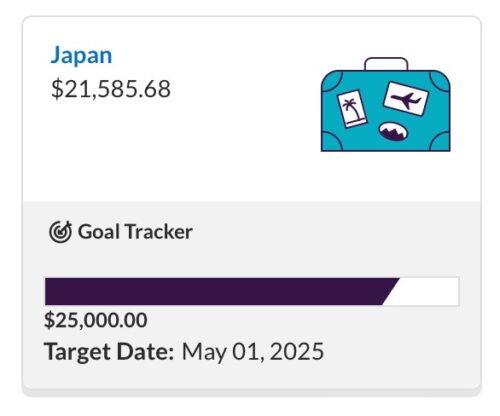
Set a deadline on hitting your goal.
Many things in life are a marathon, not a sprint. But no marathon goes on forever. You’d run out of steam!
If your financial goals aren’t time-bound in some way, you’ll be one of two things: exhausted or under-motivated.
Set a deadline for your financial goals so that you’ve got enough steam to keep going, but not so much time that you get lazy.
Getting out of debt seemed like such a monumental victory that once we did that, we just sat down and rested. For a long while. We saved our money where we could but we just tossed it into a nebulous account that didn’t really have a name.
It wasn’t very motivating.
Why Setting SMART Goals Matters
It wasn’t that we didn’t want to continue, it’s just that we weren’t really sure what to do next. We knew retirement, college, and long-term housing was important, but we were conflicted.
We also did some things that other families might not have chosen, like take the kids to France for a month paid in cash. And then England. And then Hawaii.
With each trip on the horizon, we set a smart financial goal and started socking the money away in a special bank account. We’ve set up Sinking Funds for cars, college, and weddings as well.
Just “saving money” doesn’t do it for me. Giving it a name, making it measurable, achievable, and relevant as well as time-bound, that helps me get serious about our financial goals.

More Good Ideas About Money




What do you think?
I’d be honored if you chimed in the comments section. What do you think?
This post was originally published on January 5, 2012. It has been updated for content and clarity.






On Friday my husband got a very unexpected raise. A raise that has us both seeing….our savings build!
Some basic goals this year: 1. save $3k in basic savings acct. This money will go towards our larger bills we get throughout the year, and anything that may come up. 2. we’re debating on weather we want to pay off our cars right now. We have the cash for it, but it’s a lot of cash to part with. 3. save. save. save. Aside from our mortgage and cars we have no debt. We’ve been living “paycheck to paycheck” for awhile and were not able to save as much as we had wanted. I loved reading eveyone’s responses, I am inspired and highly motivated! 😉
That is fantastic! So happy for you!
If you haven’t already, I highly recommend reading The Total Money Makeover. It has a great plan (and rationale) for paying down debt.
Thanks! We’re pretty happy about it too! We plan to keep a little extra in our checking account, and stick the rest away in savings, pretending like the raise never happened. 🙂
Thanks for this post! We are still climbing our way out of debt, and this post gives me hope for a brighter debt-free future. I appreciate you hosting a blog hop. This is my first week joining, and I posted about my experience shopping frugally without coupons: http://www.lonehomeranger.com/2012/01/frugal-grocery-shoppingwithout-coupons.html
Getting out of debt was far and away the best thing we ever did (besides get married and have kids.) Go you!
I set them. And we usually achieve them. I tend to not set goals I don’t think I can achieve, though. Hmmm…
Dreaming a big hairy dream is a little scary. My mom has always encouraged me to reach a little farther than was doable. It makes me stretch.
Wow – I am impressed with everyone else’s posts and steps in saving.
We (27 and 29, no kids) are still working on paying off debt from when we were unemployed and living with my parents after college in 2010! Oh that was the life <– heavy sarcasm. 😉 We had a couple thousand in credit card debt at the end of that year so our best decision was to get a low interest loan at a local bank.
Now to work on Step 3. And saving to move somewhere, buying or building a house.
Have you read The Total Money Makeover? For where you guys are in life, I think this would be an ideal book for you to read. I wish someone had told me about it thirteen years ago (when I was your age). Highly recommend it!
We budget what we need for living expenses and then everything else goes into a savings account for a down payment on a house. Steps 1-3 are completed and as for step 4, all of my income goes into our Roth IRA (10k, fully funded for each of us every year, this is non-negotiable) and 5% of my income goes to my 403B. Basically, I work so we can have medical/dental/vision insurance and fund our retirement. We are 28 and 29, have no children yet and have 35,000 saved for a down payment on a house but still need to focus on our goal of 50k or a down payment. I agree with the college fund sentiment, if you want something bad enough you’ll find a way!
Sounds like a fantastic plan!
Baby steps 4-6 here too! We diverted down Baby step 3b to buy a house and then went back to 4 where we’ve been plodding for the last couple of years. This year we will make significant gains in step #5 and start Baby Step 6. Last year we had to finally set aside some sink funds for the things we hadn’t replaced… furniture (everything we had was a hand-me-down from before we were married 15 years ago) and new computers (7 year old computers need replacing even if hubby is a tech guy). We also had a couple Murphy’s (mainline clean out for plumbing and a patio drain that didn’t drain). Just need to get diligent again about that snowball and throw it at the mortgage.